
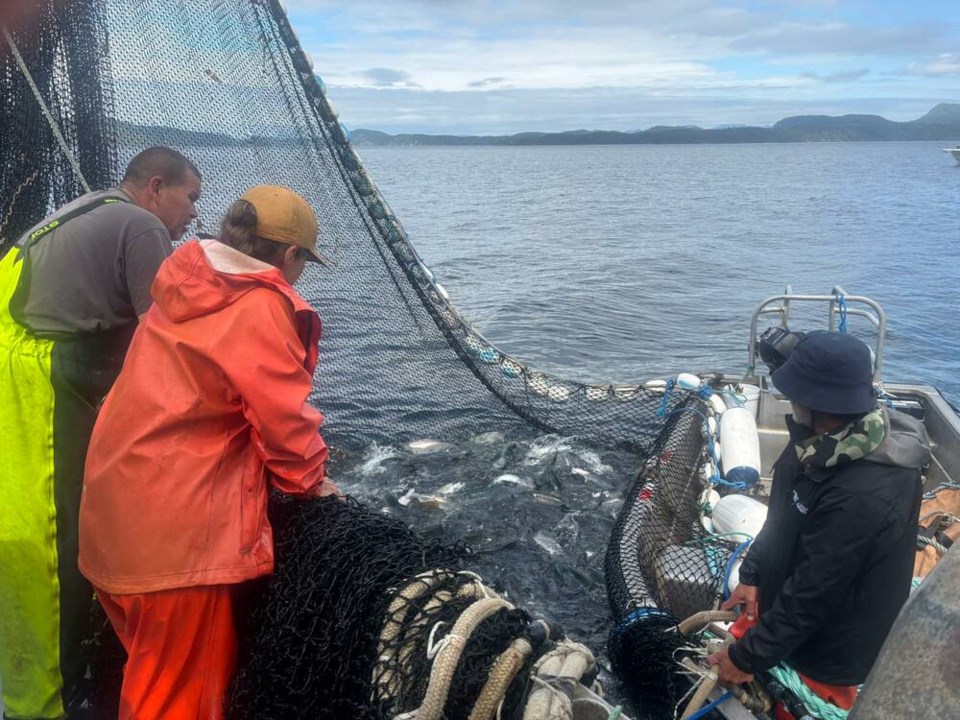
A commentary by the chief of the Tlowitsis Nation.
I write in response to the Aug. 7 article “Record number of early sockeye recorded in test catch in Johnstone Strait,” on this year’s healthy sockeye return test fisheries in my traditional territory of the Tlowitsis Nation.
Like many, I am happy to see a strong sockeye run happening, with peak numbers set to hit the Johnstone Strait soon, before the salmon head south.
However, activist Alexandra Morton’s claims that the removal of salmon farms along the east coast of Vancouver Island is why we are seeing a bounty of Fraser-bound sockeye are absolute nonsense.
As a chief and former commercial fisherman, I can confidently dispute her claims, just like the science does regarding wild-farmed salmon interaction.
These large sockeye returns have happened during peak biomass salmon farming in B.C., like 2010, and will continue to occur into the future in areas with or without salmon farms because their numbers have nothing to do with fish farms.
We need to start being honest with ourselves regarding the state of wild salmon as First Nations, former fishermen and British Columbians.
Overfishing did this. Gross mismanagement of wild stocks did this. Terrible logging practices did this. American interception of Fraser-bound sockeye is doing this.
And climate change is just beginning to rear its ugly head on wild salmon habitat.
I commend Chief David Knox for flagging these serious impacts on wild salmon in the article, and for his good work continuing to bring the governments’ attention to them.
Sockeye have long been the focus of the anti-salmon farming witch hunt because sockeye are worth the most to fishermen.
The main competition on the market is farmed salmon, and the B.C. and Alaskan commercial fisheries are an incredibly strong lobby group in Ottawa and Washington, D.C.
As a young man long before I understood the seriousness of the wild salmon decline, I would have caught every last sockeye to get every last dollar.
That was the standard greed of commercial fishing back then, and that has put us here today.
Do we retired commercial fishermen blame fish farms for poor wild salmon returns because it’s easier than looking in the mirror at the damage we did ourselves? Or the fishermen before us, our dads and uncles?
The three salmon farms in my territory have provided our nation with crucial revenue that goes toward the construction of our new community, Nenagwas, where we are building 180 homes for our members.
These farms also helped our nation create two new businesses and provide members with good year-round employment.
Revenue from these farms also goes to crucial wild salmon revitalization projects led by our Guardian Watchmen.
That work is already seeing results, as more salmon are coming back to the waterways our Guardians have cleaned up from logging damage, particularly in the Fulmore/Port Neville area.
To make real change, blame needs to shift from fish farms (proven to do little-to-no harm to wild salmon) and instead focus on the real impacts.
While we can’t do a lot about past fishing and forestry malpractices, we can continue to improve those practices and clean up their messes.
Reversing climate change is a long-term fight. We know a promising return doesn’t matter if the salmon can’t make it up dry creeks or warm rivers to spawn.
In the meantime, we should farm salmon to provide an alternative to meet global demand instead of pulling from struggling wild stocks, like we do by farming pigs and cows.
Do you go to restaurants and say you only eat wild chicken? No.
So why the microscope on farming fish?
Maybe ask yourself who’s behind the fish farm narrative and why, and who gets paid to push it.
While commercial fishing is sadly no longer a profitable career for many of us on B.C.’s coast, activism and eco-colonialism sure know how to bring in top dollar for a privileged few who exploit the plight of wild salmon to tug on heartstrings.


